
CE‑Kennzeichnung LED‑Maske: Sicher kaufen mit Prüflisten
The CE marking on an LED mask confirms that the device meets European requirements for electrical safety and electromagnetic compatibility. It says nothing about whether the mask protects your eyes from light intensity or whether it actually reduces wrinkles. This very gap causes confusion, as many buyers mistake the CE logo on the packaging for a seal of approval for effectiveness and eye safety.
Legally, CE marking for LED masks primarily covers two areas: the Low Voltage Directive (LVD) and the Electromagnetic Compatibility (EMC) regulations. Both aim to ensure that the device does not cause electric shock and does not interfere with other electronics. Photobiological safety, i.e., the protection of your retina from excessive light, is regulated by a completely different standard: IEC 62471. A manufacturer can be CE-compliant and yet not have carried out a single photobiological test.
Before purchasing an LED mask, you should therefore specifically request three documents:
- The Declaration of Conformity (DoC) with model designation and underlying standards.
- The IEC-62471 test report with report number, laboratory, and measurement conditions.
- Evidence of dermatological tests or clinical studies, if the provider advertises efficacy.
Pro-tip: Never just ask, "Is it CE-certified?", but specifically: "Can you provide me with the IEC-62471 report for this exact model, including the report number?" The answer immediately reveals whether the provider has serious documentation.
Key Findings
The CE marking of an LED mask confirms electrical and electromagnetic safety but never replaces separate proof of photobiological safety according to IEC 62471.
| Topic | Details |
|---|---|
| Understand CE Limits | CE covers low voltage and EMC, not eye safety or efficacy. |
| Request IEC-62471 Report | Check if the report number, laboratory, and measurement conditions exactly match the model. |
| Check Medical Device Status | Therapeutic claims can trigger MDR classification with a Notified Body number. |
| Compare Technical Values | Irradiance at skin contact matters more than the pure number of LEDs. |
| Transparency as a Selection Criterion | Lumora provides IEC-62471 reports, CE certificates, and dermatological tests openly accessible. |
Table of Contents
- What the CE Marking for an LED Face Mask Really Means
- CE Marking Versus Medical Approval: When Does an LED Mask Become a Medical Device?
- Photobiological Safety: Why IEC 62471 is Crucial for LED Masks
- How to Practically Check a CE Marking
- Buying Checklist: Keep Technical Features and Use in Mind
- Risks, Side Effects, and Precautions for Use
- How a Reputable Provider Documents Safety
- Tested LED Masks Instead of Vague CE Promises
- Sources
What the CE Marking for an LED Face Mask Really Means
CE stands for "Conformité Européenne" and is a self-declaration by the manufacturer, not an independent test by an authority. The manufacturer thus declares that their product complies with the applicable EU directives and affixes the mark on their own responsibility. For LED masks, two sets of regulations are particularly relevant: the Low Voltage Directive, which covers electrical safety, and the EMC Directive, which prevents the device from causing or being disturbed by radio interference.
Specifically, manufacturers test against standards such as EN 55015, EN 61547, and IEC/EN 60598-1 when they want to make luminaires and lamps CE-compliant. These standards regulate insulation, heating, creepage distances, and electromagnetic emissions. However, they say nothing about how much light reaches your retina or whether the promised collagen stimulation actually occurs.
This is the actual limitation of the CE marking, and it is often overlooked in practice. While the CE certification process for luminaires requires documentation and labeling, in many cases it does not require external testing by an independent body. The manufacturer is allowed to declare conformity themselves. This is legally permissible, but it makes CE as the sole safety argument for a device that is held directly in front of the eyes significantly weaker than many buyers assume.
A CE marking is a minimum standard for electrical and electromagnetic safety, not proof of photobiological harmlessness or cosmetic effectiveness. Those who equate the two underestimate the risk of a device used close to the eye.
CE Marking Versus Medical Approval: When Does an LED Mask Become a Medical Device?
Whether an LED mask is considered a cosmetic device or a medical product depends almost exclusively on the intended purpose as formulated by the manufacturer. If the packaging promises "visibly reduces wrinkles" or "improves skin texture," the product falls within the cosmetic sector. If, on the other hand, the manufacturer advertises "treats acne" or "alleviates rosacea symptoms," the device potentially falls under the scope of the Medical Device Regulation (MDR).
This classification has tangible consequences that fundamentally change the testing effort:
- Stricter testing regime. Medical devices undergo a clinical evaluation procedure that goes beyond mere safety testing.
- Involvement of a Notified Body. Depending on the risk class, an independent testing body (Notified Body) must confirm conformity, recognizable by a four-digit identification number next to the CE mark.
- CE according to MDR instead of the general product directive. The CE mark looks identical but stands for a completely different, significantly more complex testing procedure.
For you as a buyer, this means: check the exact wording of the efficacy claims and the user manual. A Notified Body number next to the CE logo is a strong indicator of medical classification. If it is missing for a product that explicitly advertises treatment successes, you should be skeptical. Proof of safety according to IEC 62471 and proof of efficacy through clinical studies are two separate issues that you should clarify individually before purchasing.
Photobiological Safety: Why IEC 62471 is Crucial for LED Masks
The IEC 62471 standard examines how much optical radiation a light source emits and whether this amount can harm eyes or skin. For an LED mask that lies directly on the face and often shines for several minutes a few centimeters from the eyes, this is not an academic question. Expert authorities explicitly recommend requesting photobiological test reports because the CE marking does not automatically cover this area.
A meaningful IEC-62471 report contains several measurements that you should recognize:
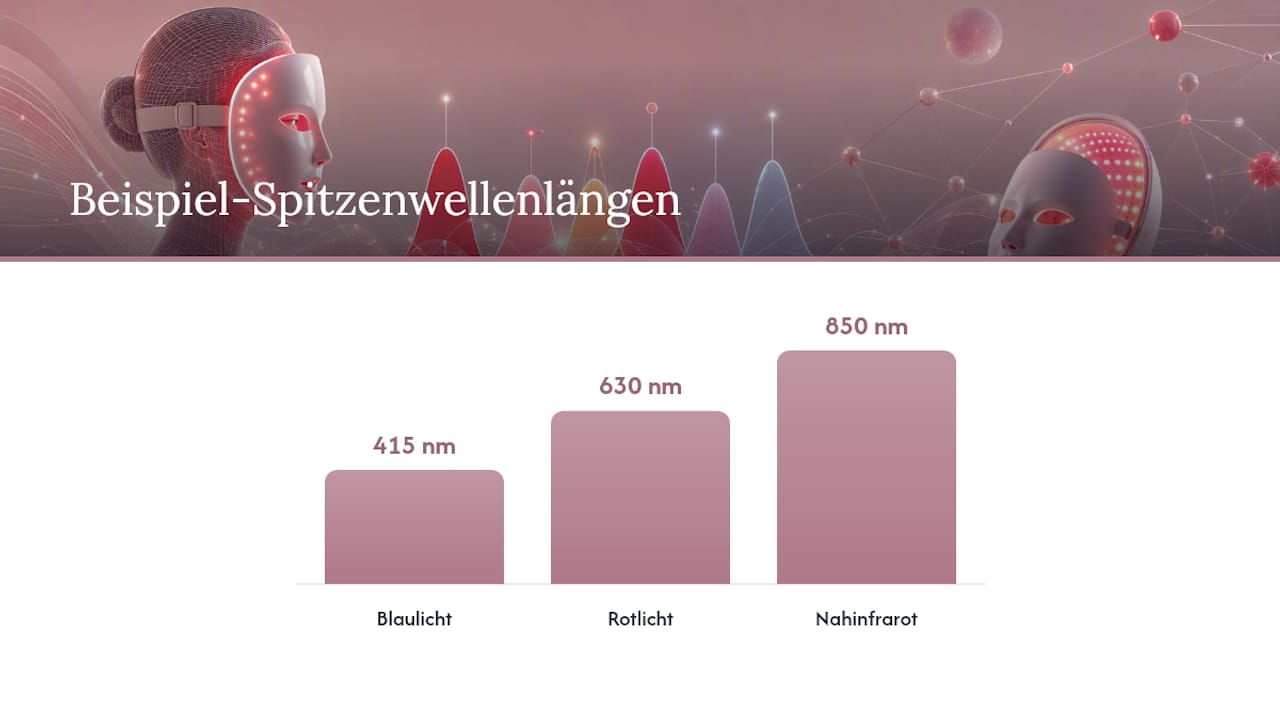
- Peak wavelength, usually given in nanometers, such as 415 nm for blue light, 630 nm for red light, or 850 nm for near infrared.
- Irradiance, measured in milliwatts per square centimeter, ideally at the actual skin contact distance and not just from 15 centimeters away.
- Risk group classification, which indicates whether the product falls into the exempt group or requires additional warnings.
- Measurement conditions, i.e., at what distance and operating time the measurement was taken.
It becomes critical especially with short-wave blue and violet light, which can trigger photochemical effects on the retina if the irradiance is too high and the exposure is too long. Red and near-infrared light are generally considered less risky but do not replace a test report, because here too, safety depends on the actual performance of the individual LEDs.
A reputable report always states the report number, the name of the laboratory, and the exact measurement conditions. If these three pieces of information are missing, the "proof" is usually just a marketing claim without substance.
Pro-tip: Explicitly ask the seller for the report number and compare it with the model number on your order. A report for a different model of the same series is not valid proof for the device you are buying.
How to Practically Check a CE Marking
A CE logo on the packaging is not sufficient as a verification step. Instead, check whether the manufacturer's address, model number, and, if applicable, a batch number are clearly stated. A provider who only shows a generic logo without traceability has often also neglected the actual test documentation.
Specifically request these documents before you pay:
- The Declaration of Conformity (DoC) with exact model designation and listed standards.
- The IEC-62471 test report with report number and laboratory.
- CE-EMC and CE-LVD certificates with their own test number, not just a collective certificate for several product lines.
- A RoHS report on pollutant limit values in electronic components.
- For mass production, ideally an ISO certificate from the manufacturing company.
Testing service providers such as SGS offer specialized photobiological and CE tests for luminaires and LED products. A manufacturer who works with such an accredited laboratory can usually provide you with a verifiable report number without hesitation.
A helpful phrasing to the seller is: "Can you provide me with the IEC-62471 report for this exact model, including the test report number and laboratory?" The response often says more than any product description.
| Warning Signal | What it means |
|---|---|
| Vague answer without report number | Probably no independent test available |
| Certificate for another SKU | Test does not cover your model |
| Only general CE logo without documents | Self-declaration without reliable proof |
| No manufacturer address on packaging | Traceability in case of complaint questionable |
Buying Checklist: Keep Technical Features and Use in Mind
The mere CE marking says little about whether a mask is pleasant and effective for your skin. Technically, it is worth looking at the number and distribution of LEDs, the actual irradiance at skin contact in milliwatts per square centimeter, and the tolerance of the specified wavelengths, e.g., 630 nm plus or minus a few nanometers.
Equally important is everyday usability. A timer with automatic switch-off prevents overdose, adjustable intensity adapts the device to sensitive skin, and a well-fitting mask body ensures that light does not scatter sideways past the eyes. Cleaning instructions and included eye protection, such as integrated covers or separate safety glasses, are also among the features that distinguish a well-thought-out product from a simple mass import.
When it comes to evidence, the order remains the same as described above: IEC-62471 report for eye safety, CE-EMC and CE-LVD numbers for electrical safety, and for efficacy claims, additional dermatological tests or clinical studies. Specific measurement values count significantly more than the pure number of LEDs, because a mask with 200 weak LEDs can be less effective than one with 100 precisely calibrated diodes.
| Criterion | What to look out for |
|---|---|
| Wavelength | Specification in nm with tolerance range, e.g., 630 nm ± 5 nm |
| Irradiance | mW/cm² at actual skin contact, not just theoretically |
| Eye Protection | Integrated cover or included safety glasses |
| Certificates | IEC-62471 report, CE-EMC/CE-LVD numbers, if applicable, dermatological tests |
Pro-tip: Never compare only the total number of LEDs between two models. Instead, ask for the measured irradiance at skin contact, as this value is decisive for the actual effect on your skin.
Risks, Side Effects, and Precautions for Use
Even a CE-compliant and photobiologically tested LED mask is not a device without any risk. The most common problems arise from light sensitivity, interactions with photosensitizing medications such as certain antibiotics or acne medications, and simply too long an application time. Overheating and slight skin irritations occur primarily when users arbitrarily extend the recommended session duration because they hope for faster results.
Sensible precautions are easy to implement: wear the included or recommended safety glasses, strictly adhere to the application duration specified by the manufacturer, and actually read the operating instructions instead of just skimming them. Consumer organizations also advise, as a precaution, not to use the mask if you have known light sensitivity or are taking photosensitizing medications.
Before the first use, you should consult a doctor if any of the following situations apply: existing eye conditions such as glaucoma, pregnancy, taking photosensitizing medications, or chronic skin conditions such as active rosacea in an acute flare-up.
An LED mask works locally but intensely. Anyone with pre-existing eye conditions or taking medications that increase light sensitivity should consult a doctor before first use, regardless of how well the device is certified.
How a Reputable Provider Documents Safety
A trustworthy provider does not hide their test certificates behind a single CE symbol but makes them openly accessible. At Lumora, this includes the IEC-62471 report with a clear test number, the CE-EMC and CE-LVD certificates for electrical safety, dermatological test results, and ISO certificates from the manufacturing site. This is supplemented by clear product data sheets that concretely name wavelengths, irradiance, and application recommendations, instead of getting lost in general advertising claims.
The actual verification happens on your end as a buyer, and it can be summarized in three steps:
- Compare whether the test report number exactly matches the model number you intend to buy.
- Check whether the issuing laboratory is accredited and has not just carried out an internal manufacturer test.
- Check the measurement distance at which the irradiance in the report was determined, as a value from 15 centimeters away says little about actual skin contact.
A manufacturer who responds evasively to specific inquiries about report numbers and measurement conditions either has no reliable test or does not want to show it. Both should be a reason for you to question the offer.
Kurzperspektive zur Bedeutung von Transparenz bei Prüfungen
In der Praxis rund um medizinische Lichttherapie zeigt sich immer wieder derselbe Effekt: Das CE‑Logo wird zur Beruhigungspille, während die eigentlich entscheidende Frage, nämlich ob ein unabhängiges Labor die photobiologische Sicherheit tatsächlich gemessen hat, unbeantwortet bleibt. Das ist kein Zufall, sondern eine Wissenslücke, die viele Anbieter bewusst nicht schließen, weil eine ehrliche Antwort manchmal unbequem ist.
Meiner Einschätzung nach ist die Bereitschaft eines Herstellers, eine konkrete Prüfberichtsnummer offenzulegen, aussagekräftiger als jedes Siegel auf der Verpackung. Ein Logo lässt sich drucken, eine überprüfbare Nummer, die zu einem akkreditierten Labor führt, nicht. Wer als Käufer diese eine Frage konsequent stellt, sortiert einen großen Teil der unseriösen Angebote von allein aus.
Profi-Tipp: Schreiben Sie Ihre Nachfrage schriftlich, per E‑Mail oder Chat, statt sie nur telefonisch zu stellen. Seriöse Anbieter beantworten das in wenigen Sätzen mit Nummer und Labor. Ausweichende Antworten fallen schriftlich deutlich schneller auf.
Geprüfte LED‑Masken statt vager CE‑Versprechen
Wer sich durch all diese Prüfpunkte gearbeitet hat, merkt schnell: Die eigentliche Arbeit liegt nicht im Lesen des CE‑Logos, sondern im Nachfragen der richtigen Dokumente. Lumora spart Ihnen genau diesen Rechercheaufwand, weil Prüfnachweise wie der IEC‑62471‑Bericht, dermatologische Testergebnisse und die CE‑EMV‑ sowie CE‑LVD‑Zertifikate zum Standardumfang der Produktdokumentation gehören, statt erst mühsam angefordert werden zu müssen.

Die Rotlichttherapie‑Maske mit 240 LEDs und vier Lichtmodi zeigt beispielhaft, wie diese Transparenz aussieht: konkrete Wellenlängenangaben, dokumentierte Bestrahlungsstärke und ein Timer mit automatischer Abschaltung, ergänzt durch klare Hinweise zur sicheren Anwendung. Wer sich einen Überblick über die gesamte Produktreihe verschaffen möchte, findet in der Rotlichttherapie‑Kollektion mehrere Modelle mit unterschiedlichem Funktionsumfang.
Dieser Abschnitt ist ein redaktioneller Hinweis auf das eigene Angebot von Getlumora, keine unabhängige Testempfehlung. Fordern Sie trotzdem, wie im gesamten Artikel beschrieben, vor jedem Kauf die konkreten Prüfberichte an, auch bei Lumora selbst. Das kostet Sie eine E‑Mail und schützt Sie vor einer Fehlentscheidung, die Ihre Augen betrifft.
Quellen
Für alle, die einzelne Prüfpunkte selbst nachschlagen möchten, lohnt sich der direkte Blick in die zuständigen Stellen und Normtexte statt nur in Verkaufsseiten.
Um eine Berichtsnummer zu verifizieren, reicht in der Regel eine kurze Anfrage direkt beim genannten Prüflabor, ob es den Bericht mit dieser Nummer tatsächlich für das angegebene Modell ausgestellt hat. Antwortet das Labor nicht oder kennt die Nummer nicht, war der vorgelegte „Nachweis“ nicht echt. Dieser eine Kontrollschritt kostet Sie wenige Minuten und schützt Sie vor genau den vagen CE‑Versprechen, die am Anfang dieses Artikels beschrieben wurden.
Dieser Artikel enthält allgemeine Informationen und ersetzt nicht die Beratung durch einen qualifizierten Arzt. Wenden Sie sich an eine qualifizierte medizinische Fachperson zu Ihrer persönlichen Lage, bevor Sie auf Grundlage dieses Inhalts handeln.